Connecting With My World

Posts tagged “Vancouver

A Global Voice

Pathway

This year, marks the 100th anniversary of Pauline Johnson’s passing.  She died on March 7, 1913 of breast cancer, three days short of her 52nd birthday. In the end, she called Vancouver home. Her last wish was to be buried in her beloved Stanley Park.  The city of Vancouver granted her request with the proviso that she be cremated. Pauline Johnson’s ashes were held in an urn encased within a small concrete vault that was gently placed in the ground.  A granite boulder, which boasted a carving of double hearts, the tribal badge of the Mohawk, marked her grave.  Today, what remains is a stone monument, established by the Women’s Club of Vancouver, as a final tribute.

Monument

Pauline Johnson was a global voice that embraced universal themes of tradition, nature and compassion.  These are dialogues that cannot be limited by time, space or culture.   She honoured the customs of the past by preserving and sharing the stories; she paved the way for women and First Nation writers and performers to boldly pursue an artist’s path; most of all, she believed that what she wrote and spoke about was important. A woman of Mohawk and English parentage, living at the turn of a new century spoke for all of humanity.  May we have the courage to do the same.

A Toast

There’s wine in the cup, Vancouver,
And there’s warmth in my heart for you,
While I drink to your health, your youth, and your wealth,
And the things that you yet will do.
In a vintage rare and olden,
With a flavour fine and keen,
Fill the glass to the edge, while I stand up to pledge
My faith to my western queen.  (more…)


The Controversy

Legends

Pauline Johnson was famous for her warm personality, affability and charisma. Many believe that her finest character traits were marked by the fondness and loyalty for her friends.   Arguably, these qualities were a compelling force during theatrical performances. Audiences were captivated by her narratives, the use of both European and First Nation attire, and stirred by the emotional nuance of her speaking voice. She was beloved by her contemporaries, yet with her passing, her reputation as a writer and poet experienced a decline. Over the years, Canadian literary critics and historians have argued that Pauline created an idealized image of the First Nation identity that was pleasing and acceptable to her “white” listeners. For that reason, Pauline was not a creditable spokesperson for their culture. She did not speak a First Nation language and spent most of her life within mainstream society.

Pauline has been disparaged by noted Canadian writers and poets such as Earle Birney, Mordecai Richler and Patrick Watson.  Even the famed Margaret Atwood confessed to overlooking Pauline Johnson when she wrote, “Survival: A Thematic Guide to Canadian Literature (1972). Instead of being a strength, it seems that Pauline’s multi-cultural heritage did not give her traction in either world.

Critics, in the end, are not infallible.  Pauline Johnson’s works have experienced a rebirth. Her importance as a figure of resistance against racism, gender bias, and human rights is coming full circle.   Pauline dedicated 30 years to her artistic endeavours.  Her contribution to the oral and written literary history of First Nation people is unequaled.  She transcends her time and gives relevance to ours.

The Canoe

The Song My Paddle Sings

West wind, blow from your prairie nest,
Blow from the mountains, blow from the west
The sail is idle, the sailor too ;
O! wind of the west, we wait for you.
Blow, blow! (more…)


A Free Spirit


Two Lives

Pauline Johnson captured the hearts and imaginations of her audience.  A talented writer, she possessed an uncanny ability to understand the needs, desires, and dreams of an unpredictable public. Early in her career, she recognized the power of combining theatre and literary endeavours to craft a vibrant and dynamic performance.  Pauline developed a her stage persona by dressing in tradition First Nation garments and using her father’s artifact collection that included such items as wampum belts and spiritual masks in her presentations.

Living during the last vestiges of the Victorian Age, Pauline Johnson was not defined by gender, but by an acceptance of her humanity.  While not directly involved, her activities positioned her in the forefront of the women’s suffragette movement.   Despite forces for change, women had few options for self-determination in the late 1800’s.  Society was doggedly rigid, accepting only those who would abide by clearly outlined rules of conduct.  Choices were limited to matrimony, striving for equality, or living a life outside of conventional norms.   Pauline Johnson’s unique ancestry offered a viable alternative.  Two cultures, two societies and two worldviews provided the necessary foundation for moving freely within a confined social structure.

The Corn Husker

Hard by the Indian lodges, where the bush
Breaks in a clearing, through ill-fashioned fields,
She comes to labour, when the first still hush
Of autumn follows large and recent yields.

Age in her fingers, hunger in her face,
Her shoulders stooped with weight of work and years,
But rich in tawny colouring of her race,
She comes a-field to strip the purple ears.

And all her thoughts are with the days gone by,
Ere might’s injustice banished from their lands
Her people, that to-day unheeded lie,
Like the dead husks that rustle through her hands.

Emily Pauline Johnson


The Storyteller

Cedars

There are defining moments in life.  For Pauline, it was the premature passing of her father, Chief George Johnson in 1884.  His death was attributed to the beatings he sustained attempting to thwart both the sale of alcohol in his community and the illegal harvesting of timber on the reserve.  Without her father’s income, their beloved home, Chiefswood was given over to renters.  The family took up residence in nearby Brantford, Ontario.

Pauline continued to write her poetry and gained modest acclaim for her first published poem “Ode to Brant” which was dedicated to the memory of Chief Joseph Brant.  However, it was her dramatic, “A Cry from an Indian Wife,” published in 1885 that garnered  immediate notoriety . In 1892, a Toronto audience of four hundred sat mesmerized as she recited the poem, based on the battle of Cut Knife Creek fought on May 2, 1885 at Battleford, Saskatchewan during the Louis Riel Rebellion. On that day, a small force of Cree and Assiniboine warriors mounted a successful defense against the mounted police, militia and the Canadian army regulars. Both sides sustained losses.

Pauline’s words were a poignant reminder of this tragic event, fresh in everyone’s memory. She spoke as no one had spoken before – as a First Nation woman.  From that moment on, she became Tekahionake, the Storyteller.

A Cry from an Indian Wife

My forest brave, my Red-skin love, farewell;
We may not meet to-morrow; who can tell
What mighty ills befall our little band,
Or what you’ll suffer from the white man’s hand?
Here is your knife! I thought ’twas sheathed for aye.
No roaming bison calls for it to-day;
No hide of prairie cattle will it maim;  (more…)


A Poet’s Beginning

Reflection

“It is dusk on the Lost Lagoon,
And we two dreaming the dusk away,
Beneath the drift of a twilight grey,
Beneath the drowse of an ending day,
And the curve of a golden moon.”

George and Emily were well known and respected.  Their home, Chiefswood, was a frequent meeting place for  intellectual and political elites such as the inventor, Alexander Graham Bell, the painter Homer Watson, anthropologist Horatio Hale and Lady and Lord Dufferin, Governor General of Canada and representative of the British monarchy.

The Biographical Notice in “Legends of Vancouver,” states that Chief George Johnson was of the “renowned Mohawk tribe, being a scion of one of the fifty noble families which composed the historical confederation founded by Haiwatha upwards of four hundred years ago.”  British law deemed that Pauline was Mohawk and a ward of the British Crown.   Her Mohawk status was not as clear within Mohawk tradition, which is based on a matrilineal culture which determines descent through the female line.

“It is dark in the Lost Lagoon,
And gone are the depths of haunting blue,
The grouping gulls, and the old canoe,
The singing firs, and the dusk and–you,
And gone is the golden moon.

Educated by her mother on works of Bryon, Tennyson, Keats, Browning and Milton; steeped in the stories told by her grandfather, John Smoke Johnson, a veteran of the War of 1812; surrounded by the natural beauty of wilderness, she wrote poetry at an early age inspired by what she embraced as a dual heritage.

O! lure of the Lost Lagoon,–
I dream to-night that my paddle blurs
The purple shade where the seaweed stirs,
I hear the call of the singing firs
In the hush of the golden moon.

E. Pauline Johnson

The Lost Lagoon

Lost Lagoon


Tekahionwake

Cedars

“Do you think you help us by bidding us forget our blood? By teaching us to cast off all memory of our high ideals and our glorious past? I am an Indian. My pen and my life I devote to the memory of my own people. Forget that I was Pauline Johnson, but remember always that I was Tekahionwake, the Mohawk that humbly aspired to be the saga singer of her people, the bard of the noblest folk the world has ever seen, the sad historian of her own heroic race. ”

Tekahionwake, Mohawk First Nation

First and foremost, she was Tekahionwake (dageh-eeon-wageh) of the Mohawk First Nation.   In English, her name meant double-life.  The name alone foreshadowed a woman who would traverse, with style and easy elegance, two vastly dissimilar worlds.   A woman destined to bridge two nations.

Her father, George H.M. Johnson, was a Mohawk Chief of the Six Nations.  Her mother, Emily Howells, was born in Bristol, England, before moving with her family to the United States to help with the Underground Railway that transported slaves into Canada.  Fate intervened. Emily moved to the Canada to live with her sister Eliza, who was married to an Anglican missionary.  A chance meeting with George led to a secret five year engagement where their love letters were kept safe in a hollow tree.  Families on both sides were vocal in their opposition to a “mixed” marriage.  Their indignation only cemented the relationship.  The marriage took place.

On March 10, 1861 Tekahionwake was born near Brantford, Ontario, the youngest of four children, a child of two ancestries.

“Never let anyone call me a white woman.  There are those who think they pay me a compliment in saying that I am just like a white woman.  My aim, my joy, my pride is to sing the glories of my own people.”
Tekahionwake, Mohawk First Nation


E. Pauline Johnson

Beach

“Sounds of the seas grow fainter, 
Sounds of the sands have sped;
The sweep of gales,
The far white sails,
Are silent, spent and dead.”

E. Pauline Johnson

I make a pilgrimage every year in March, the month of her birth and death, to her resting place, protected by a secluded grove of cedars in her beloved Stanley Park overlooking the cold waters of English Bay.  It is late in the day; the boulder that marks her grave holds the last rays of the setting sun as I quietly retrace my steps to the living world.  Even so, I feel her continued presence.


Pauline Johnson

Sounds of the days of summer
Murmur and die away,
And distance hides
The long, low tides,
As night shuts out the day.

E. Pauline Johnson, Good-bye


This week, I want to explore the life and stories of Emily Pauline Johnson.  She was charismatic, beautiful, controversial, and adored by a nation.  In recent times, she has been discredited, even considered a fraud.  Rather than taking a critic’s view, I prefer to follow her narrative.   We have started at the end; it is time to travel to the beginning.


Bagpipers are not silent!

Say thank you often, regularly, exuberantly, jubilantly, generously, and with arms wide open!

If in doubt, follow bagpipers – they make a joyful noise!

“Silent gratitude isn’t much use to anyone.” G.B. Stern


A Blessing

For that which we are about to eat, may we be truly thankful.

Granville Island, Vancouver, B.C.

“Some hae meat and canna eat, -

And some wad eat that want it;

But we hae meat, and we can eat,

Sae let the Lord be thankit.”

Robert Burns


Happy Thanksgiving

“A Day of General Thanksgiving to Almighty God for the bountiful harvest with which Canada has been blessed – to be observed on the 2nd Monday in October.”  Canadian Parliament proclamation, Thursday, January 31, 1957

I was once told that practice makes perfect; in my experience, I found that it also makes permanent.  A thankful spirit comes from practicing gratitude on a regular basis.  This week will be dedicated to thanking our family, friends, community and fellow creatures that walk with us in the world.

Vancouver Gastown Steam Clock

“God gave you a gift of 86,400 seconds today.  Have you used one to say “thank you?” William A. Ward


Talent vs. Genius

Talent hits a target no one else can hit; Genius hits a target no one else can see.
Arthur Schopenhauer

Dr. Sun Yat-Sen Gardens, Vancouver B.C.

May our eyes see beyond the obvious and take another look at the improbable, impossible and impractical…perhaps we have overlooked genius?


Back Home…

I have read many books that promise to reduce the cost of travel, yet I confess that I have never completely mastered the frugal concepts brought forth in these self-help books.  There is always a crisis, at the last minute to shred my budget. All is not lost! There is good news – travel is not limited to distance. Coming home is just the beginning of reconnecting with your own country.

“The whole object of travel is not to set foot on foreign land; it is at last to set foot on one’s own country as a foreign land.”
Gilbert K. Chesterton


A September Walk

September is my favourite month.  There is energy, freshness in the breeze as I walk on Vancouver’s famous Seawall.  On a clear September morning, I can see the water touch the mountains.

This slideshow requires JavaScript.

“Men go back to the mountains, as they go back to sailing ships at sea, because in the mountains and on the sea they must face up.”   Henry David Thoreau


What do we see?

“It’s not what you look at that matters, it’s what you see.”  Henry David Thoreau

I agree with Thoreau – what we see is all that really matters.  About a month ago, I was given the opportunity to photograph the work of an aspiring Vancouver artist. The title of his work was Daily Disasters.

The colours reflect the colours of Vancouver: bright flowers with blue skies and rain clouds.


The artist remains a mystery to me.  His paintings do not hang in an art gallery.  They belong to the public.

I see art, although some tell me it really is a garbage can.


Interest in the Future

Thomas Edison (1847-1931) held 1,093 U.S. patents in his name, including the phonograph, the motion picture camera and the most famous of all – electric light bulb.  Thirty years after his birth, another famous inventor, engineer and businessman came along – Charles Franklin Kettering (1876-1958).  He held 186 patents.  Although he does not have the “household name” familiarity of Thomas Edison, we are benefiting from his efforts.  Even though poor eyesight stymied his progress in grade school, he continued to believe that anything was possible.  (more…)


The Waterfall Building

“Buildings, too, are children of Earth and Sun.”
Frank Lloyd Wright, Architect

It is known as the Waterfall Building – another architectural landmark designed by our Arthur Erickson. Every time I pass by, I stop for a few moments just to enjoy the sounds of water, before I move on…


Oxymoron

An oxymoron is a figure of speech in which contradictory terms appear side by side. I have captured an oxymoron in this photo!  I have every confidence that one day I’ll take a photo of a bike, rather than a car, beside this bike rack.  I will then have captured a tautology….

Grammar can be exciting!


The Totem Pole

I headed out to Granville Island early this morning to meet a friend for coffee.  I chose the pathway that would lead me to the Totem Pole that stands amongst the trees, tall enough to watch over the entire Island.  It is a good start to the morning…

Totem Pole – Granville Island. Vancouver, B.C.

“If you talk to the animals they will talk with you
and you will know each other. If you do not talk to them
you will not know them, and what you do not know
you will fear. What one fears one destroys.”

Chief Dan George, Chief of the Salish Band in Burrard Inlet, B.C.


There be Dragon….Boats and Ducks

Capturing moments is not that difficult, but there are two perquisites:

1)      You need to keep your eyes open and

2)      Have a camera ready to go

I was taking my new camera out for a spin and was trying to figure out how to use the video options.  I got lucky!  I found the right button just at the point of convergence of dragons, ducks & water taxis.

Do you see the ducks?  Look for the specks. I was anxious for a split second, but they are amazing navigators.   They are able to thrive in the midst of turmoil…

P.S.  This is my first video upload – I’m making progress…


What’s Happening Underneath Our Feet?

Anything else you’re interested in is not going to happen if you can’t breathe the air and drink the water. Don’t sit this one out. Do something.”
- Carl Sagan

Imagine a life without running water, sewage systems and electricity. We depend on the availability of incoming clean water and the seamless removal of outgoing wastewater. It is a fundamental pillar of modern civilization. This post is dedicated to our city’s infrastructure. Vancouver combines utility with artistic flair.

This slideshow requires JavaScript.

Utility With Artistic Flair!


You never know who you will run into….

I met the Blue and White Warrior on the corner of Granville & Burrard.   What a surprise to see the tall, stately Terracotta figure presiding majestically over the intersection.  And where there is one, there are others waiting to be found.  You’re invited to join me on Chasing Art !  We have limited time to complete the mission.


This slideshow requires JavaScript.


‘Blue and White Porcelain-ware’

Artist: Regina Liao
Sponsor: Caorda Web Solutions
Location: 2505 Granville St
Vancouver, BC


Moments That Take Your Breath Away!

Emily Dickinson wrote:  ”The soul should always stand ajar, ready to welcome the ecstatic experience.”

I’m sure Emily Dickinson had tulips in mind when she penned those lines –

Lady Budd – Celebrating May 1st!

This slideshow requires JavaScript.


The Yellow Door That Asked Me to Honk!


Welcome! I’ve always liked the sound of that word. It means I am invited to be part of the conversation.  I came across this sign which states, quite clearly, that I was welcomed. But to enter I had to honk. Here’s the part that struck me – you need the right communication tool to take advantage of a welcome.


Walking the Sea Wall

“We write to taste life twice, in the moment and in retrospection.”  Anais Nin

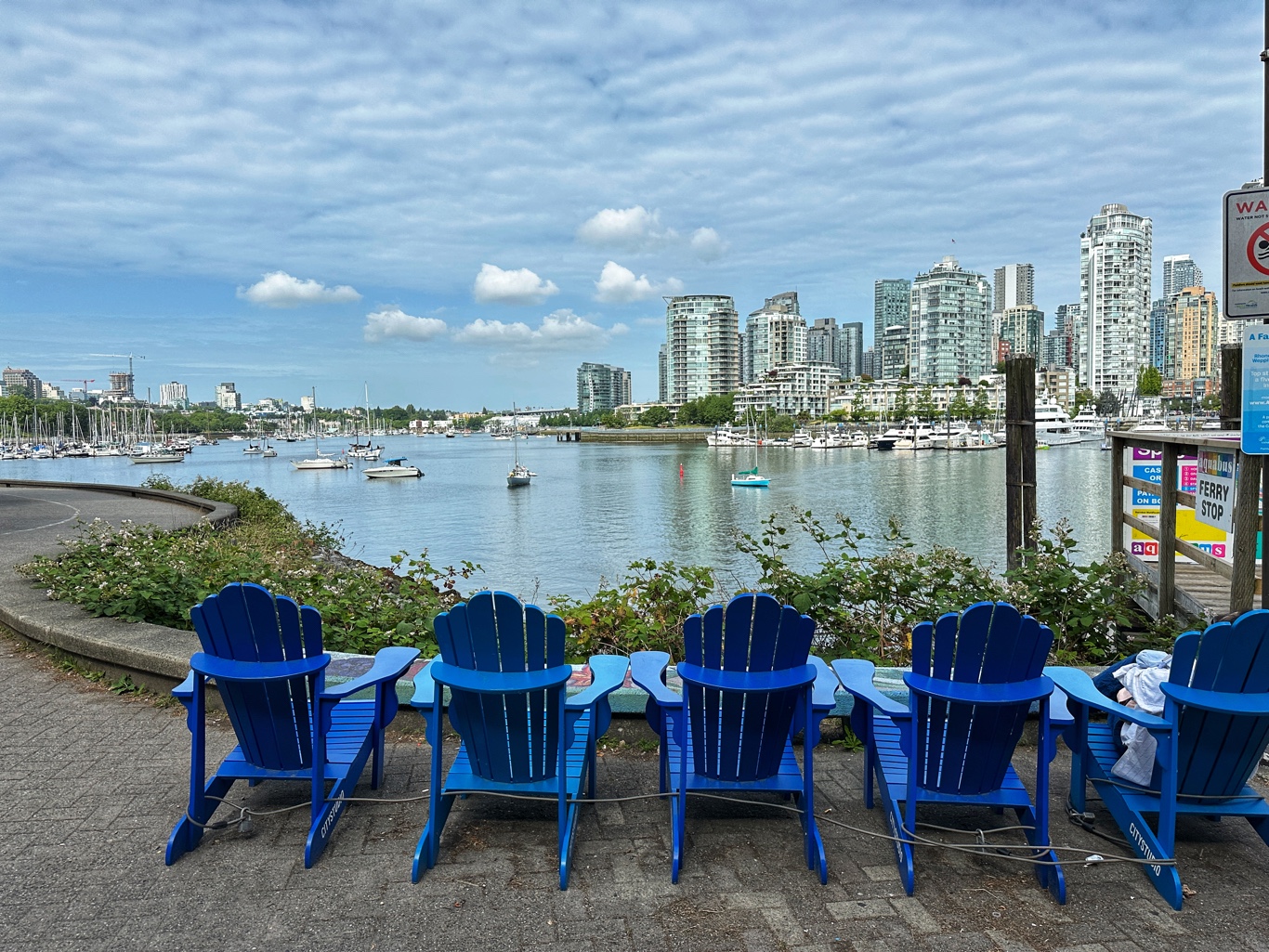
The rain clouds went missing on March 2, 2012.  There wasn’t a moment to lose. I grabbed the camera and headed out to the famous Vancouver Sea Wall and sunshine. We take photos to taste life twice… Come with me on my spring walk.    We’re heading to Granville Island, where the hot, robust coffee and fresh breads await us.

Lady Budd

This slideshow requires JavaScript.


Follow

Get every new post delivered to your Inbox.

Join 670 other followers